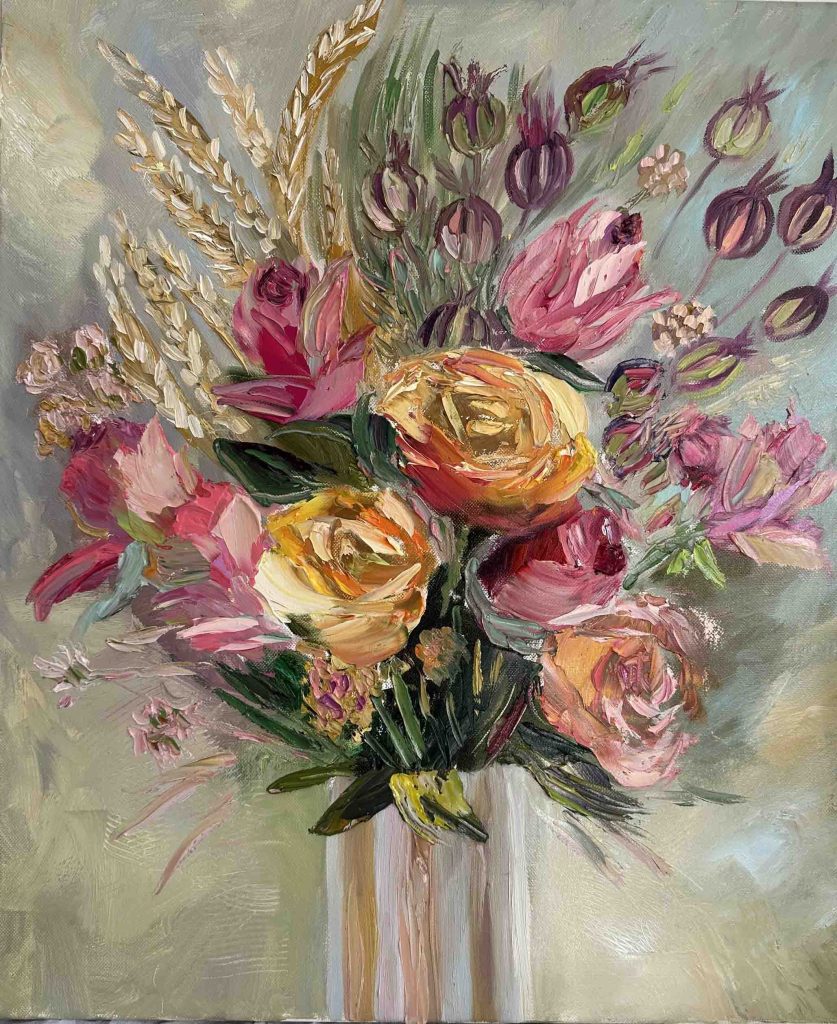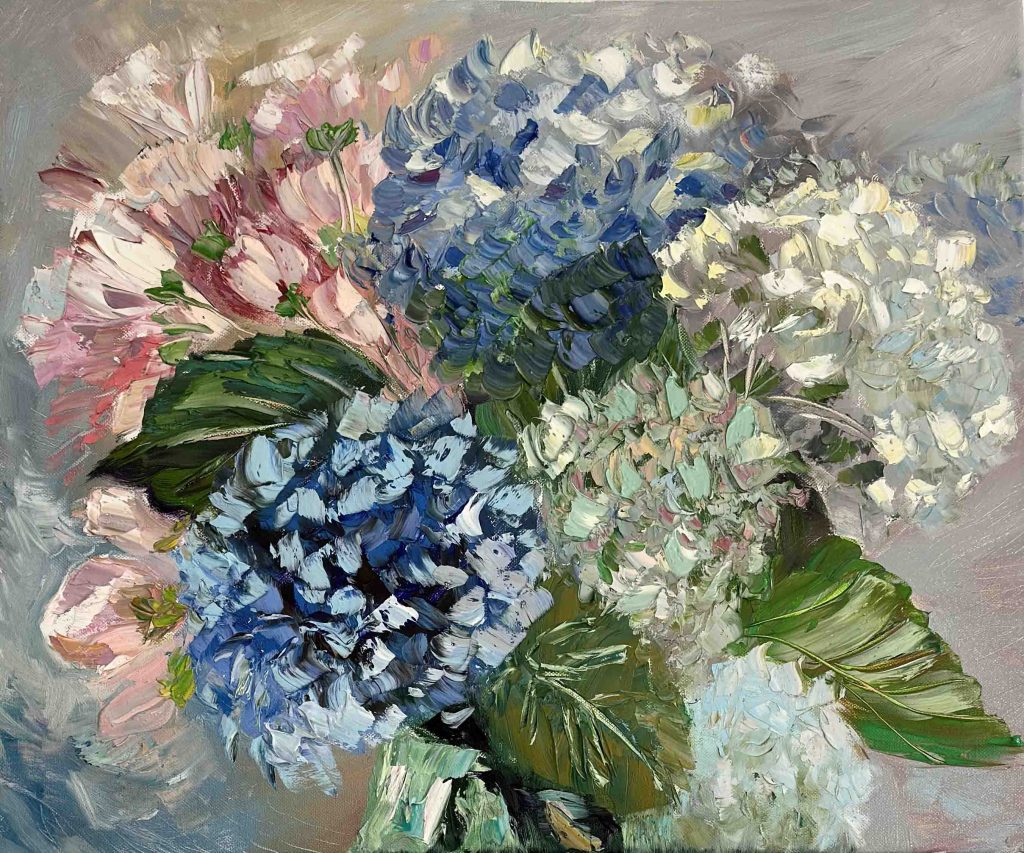
NEW BLOOMS PAINTING WORKSHOP 2.5 DAYS
HAMILTON NEW ZEALAND
Learn to paint luscious blooms in oils with a palette knife!
Sunday Nov 30 1-5.30pm
then Monday Dec 1 & DEC 2 Tuesday from 9-5.30pm
Join me for 2.5 days of fun & creativity.
Learn:Â
- how to free up your painting style
- to become a bolder painter
- how to use a generous amount of paint for luscious outcomes
- how to see more & capture more stunning colours
- what you need to know about how to capture form which you may otherwise avoid
- about the role of fresh not overworked mark making and
- how decisive application of paint feels joyful & gives energy and liveliness to your painting efforts.
NO PREVIOUS EXPERIENCE NECESSARY
Why learn oil impasto painting?
Typically newbie artists often feel timid about paint application, resulting in dry, dull and stilted outcomes.
Many get caught up in slavish detail which weakens the outcome.
With a brush in hand only, we hold the responsibility of centuries of art tradition which can .. lack freedom and be terrifying.
When we go freestyle with a palette knife and other tools and methods… something else can take place because in order to apply the paint, it’s a different amount of paint.
It’s impossible to get caught up in time consuming detail though we can deftly and boldly create tone and suggest form.
The result is bold fresh painting outcomes!
Picking up more paint and learning to be mor bold is part of the solution .
Learning to allow the paint as a material to be a contributing factor to the outcome of the artwork.
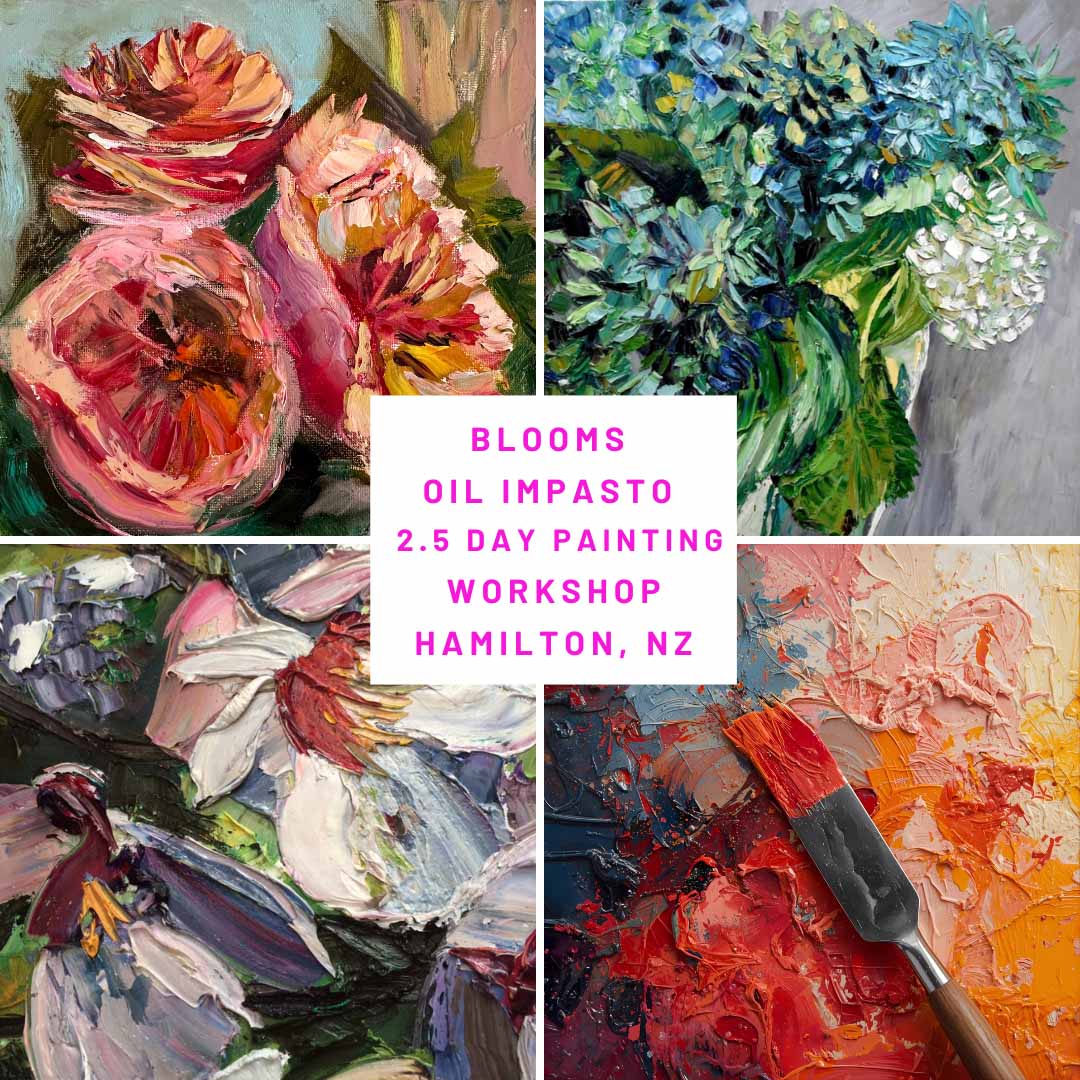
Right; Painting study roses 8 x 8 inch example. Learn to suggest shapes rather than get bogged in details.
A Note About Dietary Needs
At Blooms Painting Workshop lunches are supplied and at French art school, lunches and many dinners are supplied. Whilst we are able to cater for dairy free, vegetarian and the gluten-free, we are unable to meet the needs of celiacs, FOD-MAP, those allergic to nuts or to those where certain foods may cause medical conditions. If you have for a strong preference for no mushrooms, bacon or ham, capsicum or beans we can most likely assist you. Thank you in advance for your understanding.
What will we be doing?
We will be painting with oils gradually mastering the elements that will help students to achieve successful paintings through a series of studies (small paintings 8 x 10 inch)Â before going larger with our paintings (medium size 16 x 20 inch).
Then we will be painting 3 medium size canvases of stunning blooms choosing from hydrangeas, peonies and roses, and bouquet compositions and the choice of working from a still life.
I will also show how to use acrylics and oils in the one painting.
DAY 1 Sunday Nov 30, 2025 1pm-5.30pm
- Blooms Paint handling training with oils
- Drawing Study; Roses Tone and form & simplifying shapes
- Painting Studies; Roses
Learn how oils work then warm up with some smaller painting studies, practising mark making with original painting reference I supply and especially how to be bold with tone.
DAY 2 Monday Dec 1, 2025 9am-5.30pm & DAY 3 Tuesday Dec 2, 2025 9am-5.30pm
We move to the mid size canvases and create compositions from scratch with demos throughout. There are choices of what to paint.
I will also be setting up some paint from life compositions.
We are painting 3 mid size paintings as well as the studies to be finished by the end of the workshop.
What’s included;
- My paint brush licence for Oil paint handling training
- Palette knife training
- How to build a surface and see more colour
- How to paint from a photo and how to paint from life
- Stunning reference and painting inspiration
- Canvases, painting tools, art supplies including a generous supply of oil paints,
- Cleaning up materials
- Catered lunches, snacks, tea & coffee so you can focus on creating
- Demonstrations throughout from a generous teacher who shares breakthrough painting techniques to help you succeed with over 37 years of painting experience.
How much will I pay?
Including all of the above, the price is $1650 for the 2.5 days
and there is a maximum of 10 students.
See you in class!
Love and paint brushes, Jacqueline Coates.
FAQ’s
FAQ 1
I’ve never painted with oils before. Will I be able to do this?
Yes, you will be able to do this workshop even if you haven’t painted before.
All of my classes assume you want a thorough training so I teach from scratch and build your skills and knowledge from a common-sense NO FAIL foundation.
Whether you are a beginner or looking for creative revitalisation, you will learn what you need to in order to be able to do this too. I am on hand to provide assistance as well as demonstrations throughout.
I am known as a generous art teacher of over 30 years of experience. Check out my google reviews. I like to share knowledge to empower my students so they can have it too.
FAQ 2
What does impasto mean?
Impasto literally is Italian for paste, or paint as it comes out of the tube.
Although we thin the oil paint to use it, we also learn how to use it exactly as it comes from the tube in its thickened form allowing to build texture on the canvas.
We will start with the oils the trastional way and gradually build the thickness of paint.
It’s up to you how chunky you go. A little impasto here and there and not all over, can provide effective accents.
FAQ 3
How long do the paintings take to dry?
Oil paintings oxidise, they do not dry like acrylic paints.
This process of curing takes time, perhaps several months when we use lavish amounts of paint and less time when the paint is less thick.
The outcome is gorgeous and rich and totally worth it.
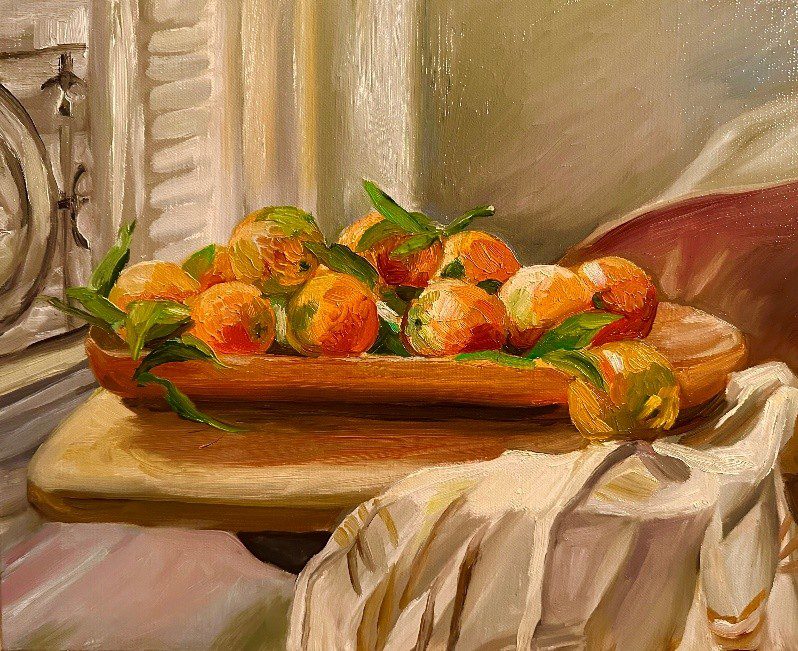
Above; Clementines still life, Paris. Oil on canvas painted from life.
FAQ 4
How will I get the paintings home?
The paintings will be wet at the end of the workshop.
We suggest you find some green grocer cardboard fruit boxes so you lay the wet paintings in the boxes and stack the boxes so the paintings get air.
Oil paintings don’t dry, they cure with oxidization from air flow. You will need to be able to drive them home after the workshop or drop them to a friend if you live a plane ride away.
Please factor this into your plans.
FAQ 5
I’m used to doing lots of detail but it’s tiring working like that. How will I produce three midsize paintings and several oil studies in 2.5 days?
It’s a bit like getting fit. We need to warm up first learning as we go, so that’s exactly what I do with the group with a number of small painting studies that allow you to try a few ideas and techniques at a time with each study.
These are low risk as not huge paintings allowing you time to try out and get the feel of the paint and the tools.
Then you gradually build fluidity and confidence with each painting.
I have allowed for 3 mid size paintings across two days after warm-ups and this is the pace that my students seem to be able to do with ease once they gain confidence from the intro training and warm ups.
FAQ 6
Sounds like a full schedule. Do we get breaks?
Although the workshop has a structure that grows your skills, you can at any time take a break with a cuppa, and we stop for lunch that is made especially for us whilst we are painting.
I like you to watch the demos and take the initial training.
FAQ 7
Can I park at the Hamilton Car Club?
Parking is free at the Hamilton Car Club and we are the onl ones using the facility whilst the workshop hours are on so there are plenty of car spaces.
FAQ 8
Where will I stay for accommodation?
There are lots of options for accommodation on Air bnb, and Booking.com
Or google the options including caravan parks which often have cabins.
FAQ 9
Which brand of paints we will use?
We will be using A LOT of oil paint so we will be using student oils.
I have imported a lot of Montmarte paints to NZ in preparation for the class which are brilliant in colour and have a great range of over 30 colours plus I will be bringing a few other favourites as well.
We use a lot of white. I like the Winsor and Newton brand for white so I will be bringing that with me from my supplies in Australia.
FAQ 10
I’ve heard oils can have fumes. Is that true? I don’t want to get a headache.
Oil paints don’t have toxic fumes because they are made from pigment and vegetable oil.
However, it’s what you put with them that determines if they will appear to produce fumes. If you use regular turps with your paint that will have fumes. There are ways to minimise that. Turps is not the only way to thin your paint.
These days you can buy odourless turps, or you can even reduce the need for using turps as I will share in the class by using other mediums. It’s important to have good ventilation when painting, which we do have at the car club.
FAQ 11
Which is better? Oils or acrylics?
Both oils and acrylics have their merits. Acrylics dry quickly which can be handy but it can also be a problem for some. You can make acrylics look like oils. Acrylics dry darker than they look when wet.
However, oil paint because it has oil in it, is luminous in combination with the pigment, and the colours are brilliant and look richer than acrylics as a result.
Oils are lovely to handle. They spread like butter, and they stay open longer, allowing you to continue to work them.
There is a place for both oils and acrylics in your painting life, and its good to explore them both.
FAQ 12
What do I need to bring to class?
Any fave brushes, though I supply brushes.
A jam jar with a screw top lid.
A painting shirt or apron.
Don’t wear your best clothes. It’s about how the paintings look.
Please bring an old sheet or tarp with you.
If you have a table top easel you can bring that along. We will have easels.
If you need a stool please bring one. The venue doesn’t supply them.
Cardboard fruit boxes to store your wet paintings safely.